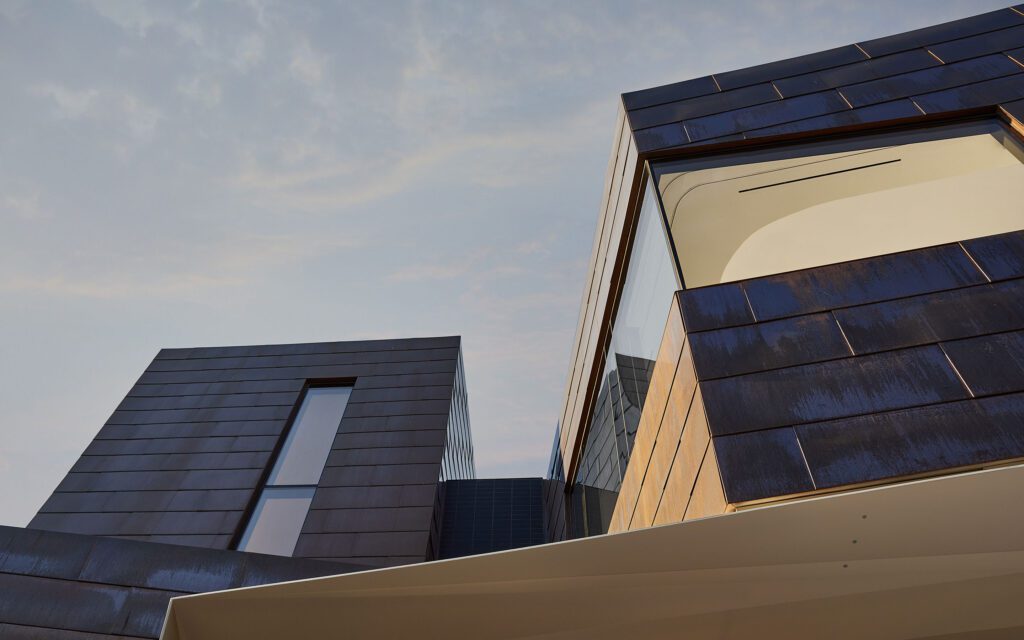
Snider House

Glass State: A New Life for Snider House

Snider House, an 1828 heritage property and North Toronto’s oldest surviving structure, was originally constructed as a brick Regency Cottage farmhouse at the heart of sprawling pastures and orchards. Over the next 180 years, the surrounding land was redeveloped and the home was expanded and modified – changes that saw its porch lost and the interior subdivided to serve a variety of occupants. In 1979, the property was designated under the Ontario Heritage Act for architectural and historical reasons.

Charged with the design of a major addition/restoration/renovation of the remarkable Snider House, it was important that the original architecture was not only restored but was also elevated to a new contemporary standard, and prepared for the next 200 years. This required an innovative design to participate in an architectural dialogue between past and present, and a strategy for contrasting the house’s historical solidity with more fluid contemporary design innovations. In this regard, the idea of the home as an amalgamation of experiences, the addition of new pieces, sections, and iterations, is an important part of the design vision.

While the property of Duplex Avenue runs perpendicular to the road, the masonry box of the house itself is skewed slightly towards Yonge Street. This prompted the idea to address this misalignment with the new addition. The addition includes an added two-storey extension with a glass curtain wall to the existing 2‑storey (plus attic) original structure, as well as extensive remodeling and reshaping of the site. The blending of new and old is an exercise in juxtaposition, where the formal/axial design of the heritage home in front will be adjusted with the organic form and modern materiality of the rear addition.

Since there was nothing salvageable from the original interior, we leaned into an appreciation of imagined original spaces. We stayed true to the home’s formal centre-hall plan, now flanked by a living room – in which we reinstated an existing wood-burning fireplace – and a generous dining room (created by combining the former parlor and dining room) that terminates with a floating service and coffee bar wrapped in smoked mirror. At the centre of the home, the staircase is a key feature, rising from the basement to the second storey with continuous seven-degree powder-coated pickets. Leather-wrapped newel posts invite tactility where it matters most.

As the interior progresses to a new rear addition and backyard, the design releases from formal symmetry and solidity towards a loose and immaterial flowing veil. Glass was a foundational material, providing a contrast to the masonry with the undulating glass façade establishing the building’s new rear perimeter and immersion into a newly constructed landscape.

Although designed to be ephemeral, the ‘glass veil’ provides the necessary weight to define a new enduring character – one that brings the house into its next generation. The new kitchen and family room invite casual conviviality. Contemporary interventions and sartorial linings assume the lightness of the new sinuous geometry of the glass addition, which now weaves through the heavy masonry walls and order of the historic structure. A custom-designed, powder-coated chandelier floats over the kitchen like a scarf in the wind.

Overlap Details

On the ground floor, the historic spaces are rendered in white, and the new addition gives way to earthy colours, which comforts, adds interest, and draws nature indoors. Materials are soft and inviting: pebble grey marble and back-painted glass cabinets meet walnut millwork in the kitchen; in the family room, deep blue felt wallcoverings, a built-in blue leather bench and wrapped leather shelving buffer acoustics. Blue and green reveals add subtle, crafted accents.

Manufactured in Spain, the curtain wall on the addition is rendered with gravity-curved glass, made on a hot sand bed, to achieve the unique rounded shape. The glass forms two “ribbons” which act like layers, wrapping the rear elevation of the masonry box in an interactive form that is playful but controlled.

While the ribbons or wrappers of glass are designed to embrace the masonry box with a lightness and seamlessness, there are also ‘peek-a-boo’ moments that create a unique detail of the old and new. There are many examples of this, the best being on the south elevation where the millwork wraps around and becomes an enclave joining with the curtain wall, so that the original corner of Snider House is put on display. This element demonstrates the intensity of experience that Snider House aims to create with the emotive stitching of old and new architectures.

To further preserve the integrity of the heritage envelope, close attention was paid to the science of building systems, reinforcing the masonry to be watertight and heatproof to ensure the original home both looks and performs well.

In the unconventional backyard, a deck and raised swimming pool sit level with the house’s ground floor, and the dining and lounging areas feel “carved” into the spaces below. This unique design was determined as much for its environmental impact (to forego excavation for the pool) as much as to create engaging and expansive experiences within the relatively tight space.

Project Facts

  • Client

    Withheld

  • Location

    Toronto, Ontario

  • Size

    5,812 sq.ft

  • Status

    Complete

  • Sub-Consultant Team

    Structural — Cucco Engineering + Design

    Mechanical — ZAAB Consulting

    Heritage — ERA Architects Inc.

  • General Contractor

    THL Construction Management

  • Renderings

    Office In Search Of

  • Photography

    Scott Norsworthy
    Jody Cash

Share